
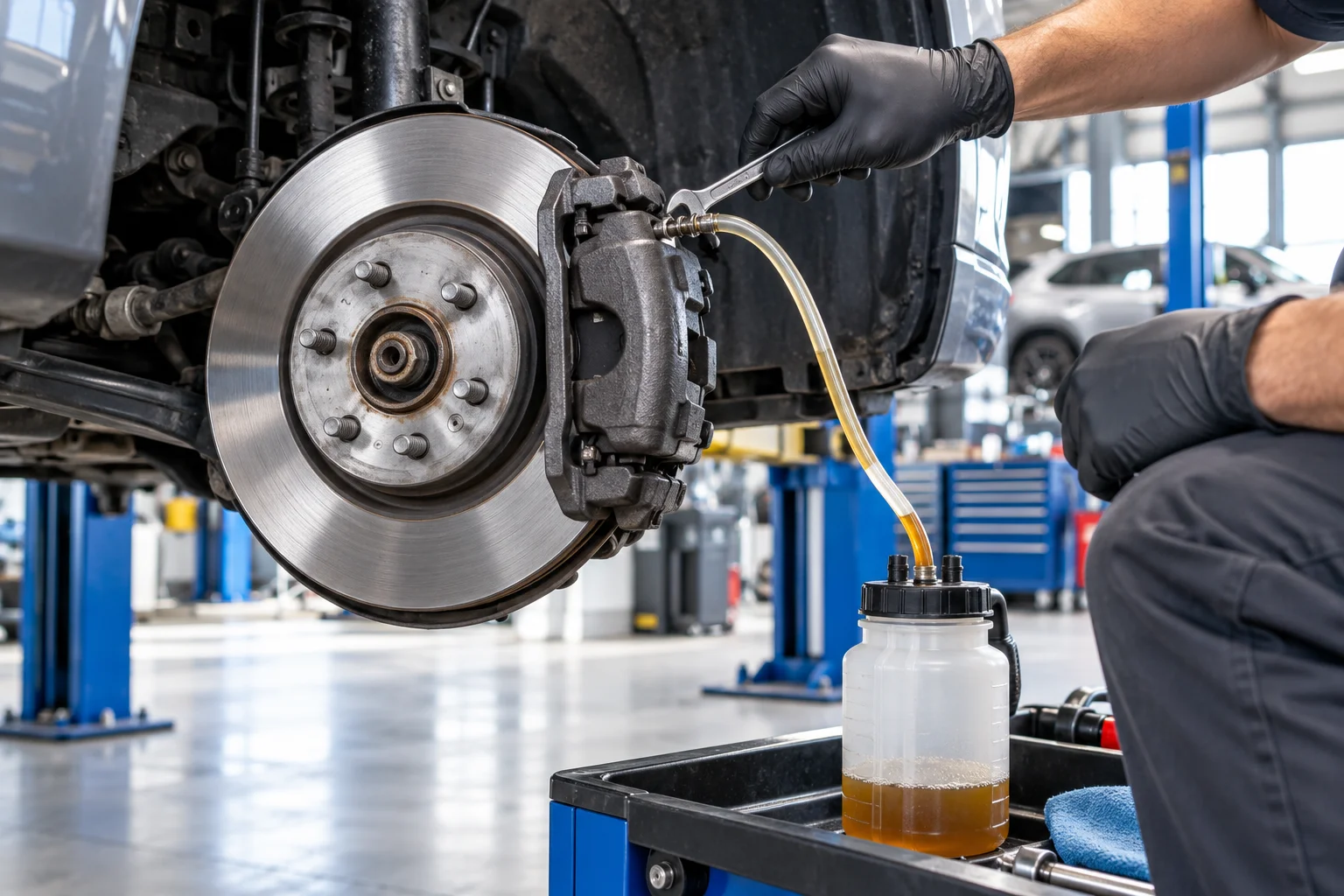
Yes, a brake flush is necessary when your vehicle’s manufacturer recommends it or testing shows that the brake fluid has deteriorated or become contaminated. Brake fluid absorbs moisture over time, which can lower its boiling point and contribute to corrosion inside the braking system. A brake fluid flush removes the old fluid and replaces it with the correct fresh fluid. Many vehicles require brake fluid replacement every two to three years, but the recommended interval varies by manufacturer and model. Following your owner’s manual and checking the fluid’s condition can help maintain reliable braking performance and prevent avoidable repairs.
Your vehicle’s braking system is one of its most important safety features. While most drivers regularly think about brake pads and rotors, brake fluid is another essential component that deserves attention. This fluid transfers the pressure you apply to the brake pedal to the components that slow and stop your vehicle.
Over time, brake fluid can absorb moisture and lose some of its original performance characteristics. This is why automotive repair shops may recommend a brake flush as part of routine maintenance.
But is brake flush service necessary for every vehicle? Does it make a noticeable difference if your brakes seem to work normally? And how can you tell whether a mechanic’s recommendation is justified?
A brake flush is a maintenance procedure that replaces old brake fluid throughout the hydraulic braking system with fresh fluid that meets the vehicle manufacturer’s specifications.
Your vehicle uses hydraulic pressure to operate its brakes. When you press the brake pedal, the master cylinder pressurizes the fluid, transmitting force through the brake lines to the calipers or wheel cylinders. These components then apply the braking force needed to slow the wheels.
Brake fluid must maintain the appropriate properties to perform this job reliably. Unfortunately, certain types of brake fluid absorb moisture over time, even when the system appears to be sealed.
During a brake flush, a technician removes the old fluid from the system and introduces fresh fluid using an appropriate service procedure. The process is designed to replace degraded fluid in the hydraulic circuits, not just the fluid visible in the reservoir.
Depending on the vehicle, specialized equipment or diagnostic procedures may be required to service the anti-lock braking system (ABS) correctly.
A brake flush is different from simply topping off the reservoir. Adding fresh fluid to old fluid does not replace all the degraded fluid already circulating through the system.
Brake flush service matters because brake fluid gradually changes as it absorbs moisture and experiences heat during normal operation.
Here are the main reasons why timely fluid replacement can be important.
Many vehicles use glycol-based brake fluids, including DOT 3, DOT 4, and DOT 5.1. These fluids are hygroscopic, meaning they absorb moisture over time.
Moisture can enter through microscopic pathways in system components and through normal exposure during maintenance. Even though the braking system is designed to be closed, its fluid does not necessarily remain moisture-free throughout the vehicle’s life.
As water content increases, the fluid’s boiling point decreases. During heavy braking, particularly when driving down steep hills or repeatedly stopping at high speeds, brake temperatures can rise substantially.
If the fluid becomes hot enough to boil, vapor bubbles can form. Unlike liquid brake fluid, vapor is compressible, which can interfere with the hydraulic pressure needed to operate the brakes.
Replacing degraded fluid helps restore the fluid’s intended properties and reduces this risk.
Brake fluid must transfer pressure consistently whenever you press the pedal.
When the fluid is in poor condition, its reduced boiling performance can become a concern during demanding driving conditions. Drivers may not notice a problem during ordinary trips, but heavy braking can expose weaknesses that were not apparent during routine driving.
Fresh, manufacturer-approved brake fluid helps the system operate as designed.
However, a brake flush cannot correct every braking problem. Worn brake pads, damaged rotors, leaking brake lines, and faulty hydraulic components require their own diagnosis and repairs.
Moisture in brake fluid can contribute to corrosion inside the hydraulic system.
Affected components may include brake lines, calipers, the master cylinder, and parts of the ABS hydraulic unit. Corrosion can interfere with component operation and potentially result in expensive repairs.
Replacing brake fluid at the appropriate interval helps maintain the fluid’s protective properties.
It is important to understand that a flush cannot reverse existing corrosion or guarantee that hydraulic components will never fail. Its purpose is preventative maintenance.
Certain driving situations place greater demands on the braking system.
Examples include:
These situations can generate significant brake heat. Because moisture lowers brake fluid’s boiling point, maintaining the fluid according to the manufacturer’s recommendations is particularly important.
There is no single replacement interval that applies to every vehicle.
Many manufacturers specify a time-based brake fluid replacement schedule, and intervals of approximately two to three years are common. However, some vehicles have different requirements, so your owner’s manual and maintenance schedule should take priority.
Brake fluid can deteriorate with time even if you rarely drive your vehicle. This means mileage alone is not always a reliable indicator of whether a flush is due.
Consider these factors when determining your vehicle’s maintenance needs:
Manufacturer recommendations: Check the maintenance schedule for your exact make, model, and model year.
Previous service history: If you cannot confirm when the fluid was last replaced, ask a technician to assess its condition and determine the appropriate next step.
Fluid condition: Moisture-content or boiling-point testing can provide useful information about whether the fluid needs replacement.
Driving conditions: Frequent heavy braking, towing, and mountainous driving may place additional demands on the braking system.
According to HELLA’s brake fluid maintenance guidance, moisture affects the fluid’s boiling point and can contribute to corrosion. The guidance also emphasizes following the vehicle manufacturer’s replacement interval.
Brake fluid does not always show obvious symptoms when its condition deteriorates. Therefore, it is better to follow the maintenance schedule and appropriate testing rather than relying on warning signs alone.
The following observations may indicate that your braking system needs professional attention.
Fresh brake fluid is generally clear to light amber, depending on its formulation. Fluid that appears dark brown or cloudy may have aged or become contaminated.
However, color alone cannot reliably establish the fluid’s moisture content or boiling point. A technician may need to perform an appropriate test before recommending replacement.
A brake pedal that feels unusually soft or spongy may indicate air in the hydraulic system, fluid-related problems, or another brake system fault.
This symptom should not automatically be attributed to old brake fluid. A leak, failing master cylinder, or other hydraulic problem may also cause it.
If the pedal suddenly becomes soft, sinks toward the floor, or braking performance decreases, stop driving when safe and arrange professional assistance. Do not assume a routine flush alone will resolve the issue.
Sometimes, the clearest reason for a brake flush is simply that the scheduled replacement date has arrived.
You may not notice a difference in pedal feel when the fluid is overdue. Nevertheless, following the manufacturer’s maintenance requirements helps prevent deterioration from going unaddressed.
Review your service records and ask your repair shop to confirm the correct interval for your vehicle.
A technician may use a suitable tester to evaluate moisture content or determine the fluid’s boiling point.
If the result falls outside the manufacturer’s or fluid supplier’s acceptable limits, replacement may be necessary.
Ask the technician to explain the test result and how it relates to your vehicle’s maintenance requirements. A specific measurement is more informative than an unexplained recommendation.
Certain brake repairs require the hydraulic system to be opened. Examples include replacing a caliper, master cylinder, or brake line.
Depending on the work performed, the system may need to be bled to remove air and may require fresh fluid. This does not mean every brake pad replacement automatically requires a complete flush.
Your mechanic should explain which procedure is necessary for the repair being performed.
Neglecting brake fluid maintenance can create problems that become expensive or dangerous over time.
As moisture accumulates, the fluid’s boiling point can decrease. Under demanding braking conditions, this can increase the risk of vapor formation and reduced braking performance.
This risk is especially concerning during repeated hard braking or long downhill descents.
Moisture can contribute to corrosion inside the braking system. Over time, corrosion may damage hydraulic components or interfere with the operation of small valves and passages.
Repairs involving components such as the master cylinder or ABS hydraulic unit can be significantly more expensive than routine fluid replacement.
Deteriorated fluid does not automatically cause every brake component to fail. However, neglected fluid maintenance can increase the risk of moisture-related damage.
If a hydraulic component develops a fault, the vehicle may need more than a flush to restore safe operation.
A scheduled fluid service is generally less expensive than repairing major hydraulic components. Although a flush cannot prevent every failure, following the recommended interval can help reduce avoidable moisture-related deterioration.
These services are related, but they serve different purposes.
Service | Main purpose |
Brake flush | Replaces old brake fluid throughout the hydraulic system |
Brake bleeding | Removes trapped air from the brake hydraulic system |
Brake fluid top-off | Adds fluid to the reservoir when appropriate |
Brake inspection | Checks components and identifies potential problems |
A brake bleed is commonly performed after a hydraulic component has been replaced or the system has been opened. Removing trapped air is essential because air can interfere with hydraulic pressure.
A brake flush focuses on replacing old fluid. Depending on the vehicle and the work performed, the technician may also need to bleed the system as part of the service.
Neither procedure repairs a leaking brake line, worn brake pads, damaged rotors, or a defective master cylinder. Those problems require separate attention.
Brake flush service commonly costs approximately $80 to $200 in the United States, although prices can fall outside this range depending on the vehicle and repair facility.
The final price may depend on:
Some repair shops include a brake fluid flush in a maintenance package, while others charge for it separately.
Before approving the service, ask what the quoted price includes. Confirm whether the shop will replace fluid throughout the hydraulic system, use the correct specification, and perform any required bleeding procedures.
If a mechanic recommends a flush, ask why it is due now. The answer should relate to your vehicle’s maintenance schedule, fluid testing, service history, or a specific repair requirement.
Not necessarily.
A normal-feeling brake pedal does not confirm that the fluid is still within its recommended condition limits. Moisture contamination can develop gradually without producing an obvious change during everyday driving.
If your vehicle is within its recommended service interval and the fluid has no documented issue, an immediate flush may not be necessary.
However, if the service is overdue or testing indicates that the fluid has deteriorated, the fact that the brakes feel normal is not a good reason to ignore the recommendation.
The best approach is to review the maintenance schedule and use appropriate testing when needed.
A reputable technician should be able to explain why the service is recommended instead of insisting that every vehicle needs a flush at an identical mileage.
Brake fluid maintenance is important, but the service should be based on your vehicle’s actual requirements.
The manufacturer’s maintenance schedule is the best starting point. It provides model-specific guidance rather than relying on a generic interval for every vehicle.
Save invoices and maintenance records showing when your brake fluid was last replaced. These documents help prevent unnecessary repeat services.
If the shop says your brake fluid has too much moisture or has failed a condition test, ask to see the reading and how it compares with the applicable replacement threshold.
Confirm whether the technician is performing a complete fluid exchange, bleeding the system, or simply adding fluid to the reservoir.
These are different procedures, and the estimate should reflect the work required.
Brake systems require the correct fluid specification and proper servicing procedures. A technician should follow the manufacturer’s instructions, particularly when the vehicle’s ABS system requires specialized bleeding procedures.
Professional automotive service providers such as Uptown Import can help drivers understand routine maintenance recommendations and determine which services are appropriate for their vehicles.
A brake flush is worth the expense when it is required by the manufacturer’s maintenance schedule, supported by fluid testing, or necessary as part of an appropriate brake system repair.
Its value comes from replacing deteriorated fluid and helping maintain the braking system’s intended performance and corrosion protection.
However, it is not a universal solution for every brake problem, and it does not need to be performed at every oil change unless the vehicle’s requirements happen to make it due.
For the best result, base the decision on your vehicle’s maintenance schedule, documented service history, and the condition of the fluid rather than a generic sales recommendation.
So, is brake flush service necessary? Yes, when your vehicle’s maintenance schedule calls for it or the brake fluid’s condition shows that replacement is needed.
Brake fluid absorbs moisture over time, which can lower its boiling point and contribute to corrosion inside the hydraulic system. Replacing degraded fluid helps maintain reliable braking performance and can reduce the risk of avoidable moisture-related damage.
The correct replacement interval varies by vehicle, so always consult your owner’s manual. If your mechanic recommends a flush, ask for the reason, check your service records, and request appropriate test results when applicable.
Most importantly, do not ignore a soft brake pedal, a sudden change in braking performance, or visible fluid leakage. These symptoms may indicate a problem that requires immediate diagnosis rather than a routine flush alone.
Regular brake inspections and properly scheduled fluid replacement are practical ways to help maintain your vehicle’s safety and reliability.