
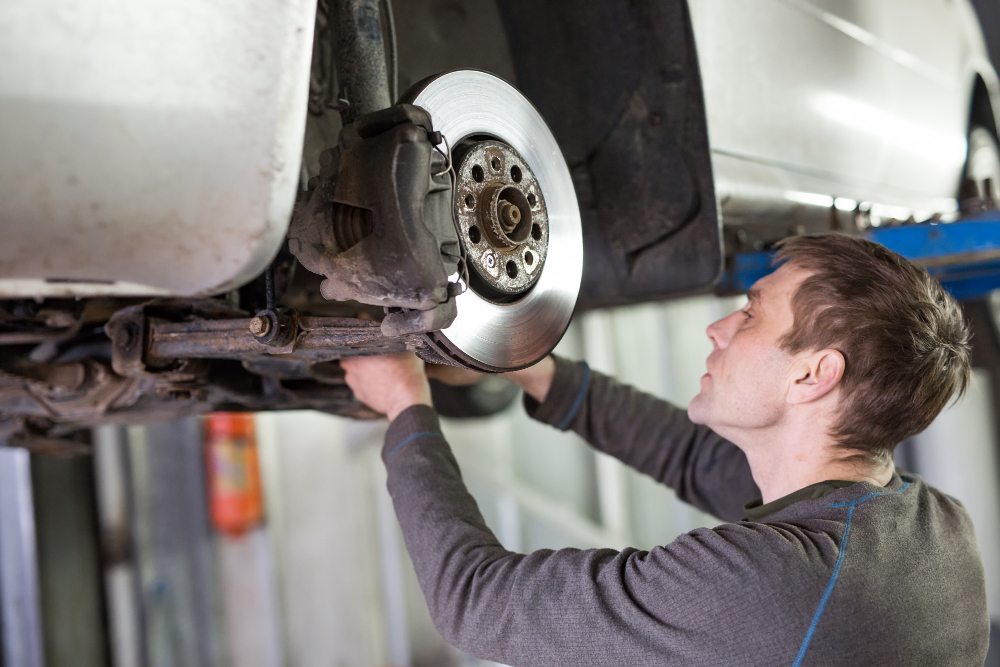
A grinding noise when braking usually makes drivers assume that the brake pads have worn out. That is a sensible first suspicion, but what if an inspection shows that the pads still have plenty of material left? The noise should not be ignored. Braking involves several moving and load-bearing components, and a fault elsewhere in the system can produce a harsh scraping or grinding sound even when the pads appear fine.
Some causes are simple, such as a stone caught near the disc. Others, including a sticking caliper or damaged wheel bearing, can affect control and stopping performance. The safest response is to arrange a proper inspection.
Disc brakes slow a vehicle by pressing pads against a rotating metal disc. Grinding normally means that two components are rubbing incorrectly or a part is no longer moving freely.
A noise that appears only when the pedal is pressed often points towards the disc, caliper, pad hardware or a foreign object. Grinding that continues while driving and changes with road speed may come from a wheel bearing or dust shield. Sound alone cannot confirm the fault.
Brake pads can remain within their wear limit while the discs become scored, corroded, warped or excessively thin. Deep grooves can develop when debris becomes trapped between a pad and disc, while corrosion is common on vehicles that have been parked for a long period. Light surface rust after rain may clear after a few normal stops, but heavy corrosion can create persistent noise and uneven braking.
A technician should check both disc faces for scoring, heat damage, cracks and heavy rust, then measure the disc against the manufacturer’s minimum thickness. A damaged disc may need resurfacing or replacement. Pads and discs are normally serviced in axle pairs to keep braking balanced.
A small stone can become lodged between the brake disc and its protective backing plate. This may create an alarming metallic scraping sound even though the braking components themselves are still usable. The noise might begin suddenly after driving over gravel, through roadworks or along an unpaved surface.
Debris must be removed with the vehicle safely supported. Never work beneath a vehicle held only by its standard jack. If the cause is not obvious, let a qualified technician inspect it.
Behind many brake discs is a thin metal plate designed to limit the amount of water and debris reaching the assembly. This dust shield or backing plate can become bent through impact, corrosion or previous repair work. If it touches the rotating disc, it can produce continuous scraping or grinding that becomes faster as the vehicle speeds up.
The repair may involve repositioning the shield or replacing it if it is heavily corroded. The contact point can be difficult to see without lifting the vehicle and rotating the wheel.
The caliper must apply and release the pads smoothly. A seized piston, corroded slider pin or damaged guide can keep one pad pressed against the disc after the pedal is released. This creates excess friction and heat, often accompanied by grinding, a burning smell, reduced fuel economy or the vehicle pulling to one side.
One wheel may become much hotter than the matching wheel on the other side. Do not touch the brake assembly, as it may cause a burn. Continued driving can damage the disc and pad or make the car difficult to control. Repairs may involve servicing the sliders, replacing hardware or fitting a new caliper.
Pads can have adequate friction material yet still move incorrectly inside the carrier. Missing or distorted anti-rattle clips, worn retaining hardware, incorrect pad fitment or a loose component can allow metal parts to contact the disc. A pad can also wear unevenly; the outer pad may look healthy while the inner pad has become dangerously thin because of a caliper problem.
Checking pads through a wheel opening is therefore incomplete. Both pads, their mounting surfaces, shims, clips and wear indicators must be examined. If the noise began after brake work, have the installation checked immediately.
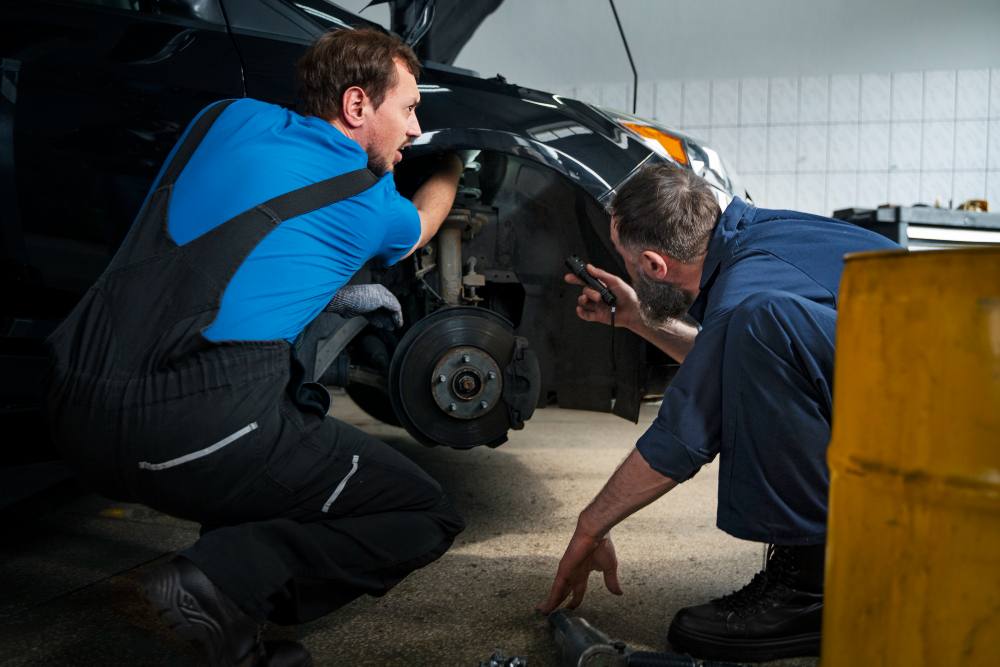
A failing wheel bearing may rumble, growl or grind and can easily be mistaken for brake noise. The sound often changes with vehicle speed or when the car turns and transfers weight from one side to the other. In more advanced cases, there may be looseness at the wheel, vibration or irregular tyre wear.
Wheel bearings support the wheel, so failure is a safety concern. A technician can check for play, roughness and noise while ruling out tyre and brake faults. The bearing or complete hub assembly may require replacement.
During hard braking or on a slippery surface, the anti-lock braking system rapidly adjusts hydraulic pressure to help prevent the wheels from locking. The driver may hear a mechanical buzzing or grinding-like sound and feel the brake pedal pulse. This can be normal while ABS is actively operating.
Regular activation during gentle braking on a dry road is not normal. It may indicate a damaged wheel-speed sensor, corroded sensor ring or wiring fault. If the ABS warning lamp is on, the system should be checked professionally.
It is unwise to keep driving until the cause is known. Stop as soon as it is safe if braking performance has weakened, the pedal feels unusually soft or hard, the vehicle pulls sharply, a warning light appears, smoke or a burning smell is present, or one wheel is excessively hot. Arrange recovery rather than driving the vehicle to a garage.
Even if braking feels normal, avoid unnecessary travel and book an inspection. A cheap obstruction or bent shield can become an expensive disc, caliper or hub repair. Brakes are not a system on which to gamble; the prize for guessing wrong is dreadful.
A proper inspection may include a road test, followed by checks of the following components:
Replacing good pads without finding the contact point wastes money and leaves the real problem untouched.
If there is a grinding noise when braking but the pads are fine, the problem may involve damaged discs, trapped debris, a bent dust shield, sticking caliper, loose hardware, a worn wheel bearing or an ABS fault. It is also possible that the visible pad is healthy while the hidden inner pad is badly worn.
Because these faults can compromise braking or wheel stability, visual reassurance about the pads is not enough. Limit driving and arrange a complete inspection. Finding the cause early protects the vehicle, avoids unnecessary replacement parts and keeps every journey safer.