
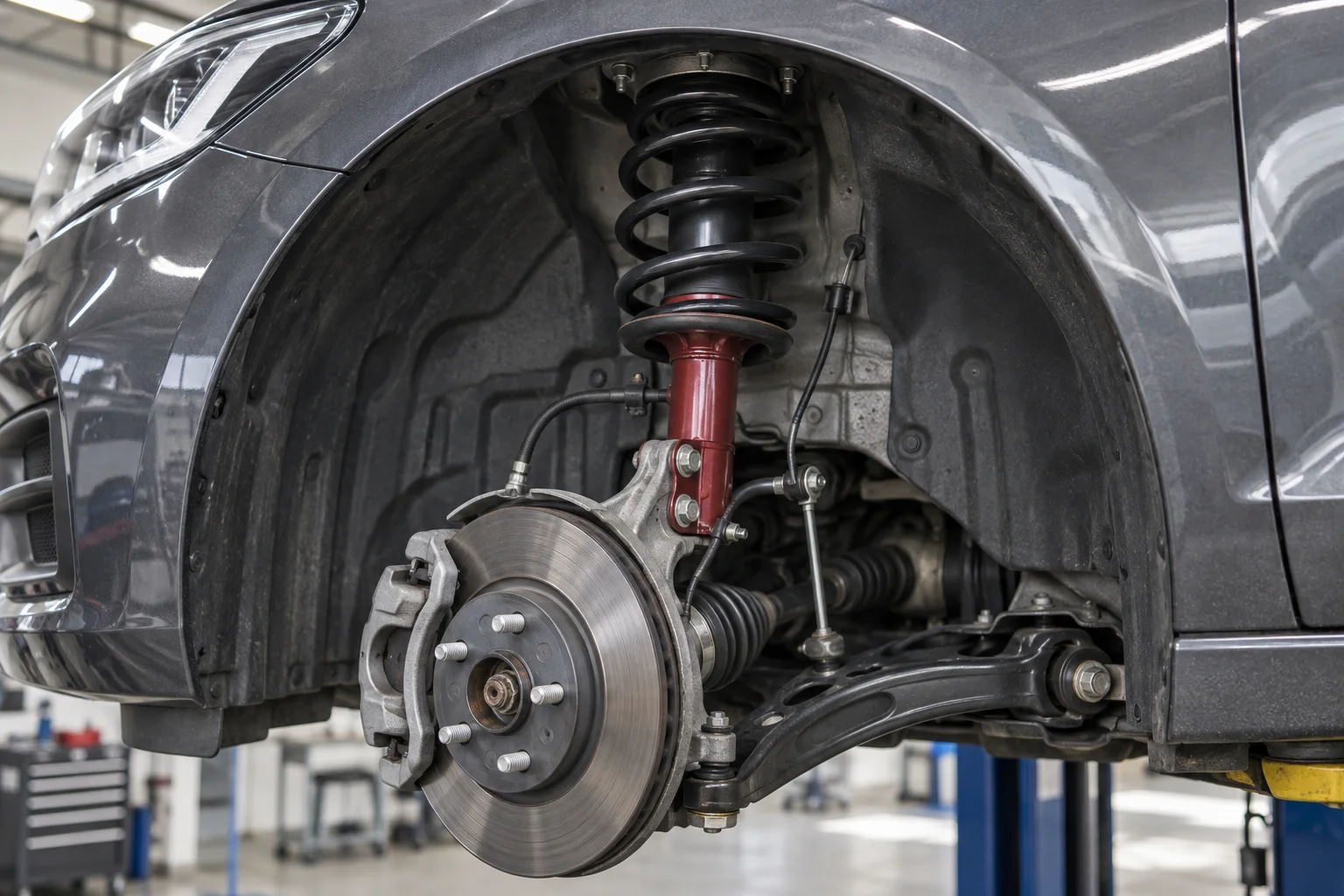
A car suspension system is an arrangement of mechanical parts that joins the wheels to the vehicle’s body or chassis. It helps vehicles minimise road impacts and vibrations from uneven road surfaces, thereby maintaining tyre contact with the road. This plays a crucial role in offering a smooth, comfortable ride, which enhances vehicle stability and ensures better handling. Understanding how car suspensions work, their main components, and different existing types can help you identify their importance in your vehicle’s performance and safety.
A car suspension system offers several critical functions. Some of these are:
The suspension enables the wheels to adjust to different road conditions. At the same time, it helps the tyres to maintain contact with the surface. This is crucial as continuous tyre contact offers the grip required for steering, braking and acceleration.
The movement of the vehicle can be controlled by the suspension when accelerating, braking and turning. It helps minimise unnecessary body movement, which involves body roll when cornering and pitching when braking and accelerating.
If your vehicle crosses over potholes, bumps or uneven surfaces, the wheels experience unexpected movements and vibrations. The parts of the suspension reduce road shocks and handle the resulting energy to avoid extreme jolts reaching the vehicle’s body and passengers.
The suspension minimises the amount of movement transmitted to the cabin by reducing the effects of road shocks and vibrations. This ensures a smoother driving experience, especially on uneven roads and longer trips.
A car suspension system operates through the combined function of springs, shock absorbers and other parts. The wheel movement is controlled by these parts when your vehicle crosses over uneven road surfaces. This process includes several stages from the first movement caused by the bump to the wheel returning to its original position.
The tyre encounters a sudden effect that causes the wheel to move upwards when the vehicle crosses over a pothole, bump, or uneven surface. This movement stimulates the suspension system, allowing it to respond to the changes in the road surface.
The suspension spring compresses when the wheel lifts upward, which absorbs the energy. Once the pressure is released, it expands, which allows the wheel to turn back to its resting position.
The spring, by itself, does not control the movement, as it might continue bouncing after the initial effect. The shock absorber controls this movement by controlling the spring’s compression and extension. This damping behaviour helps to avoid unnecessary bouncing and helps maintain vehicle stability.
The spring extends and enables the wheel to return to its normal position when the load is removed. The shock absorber consistently controls the movement, which helps the tyre maintain contact with the surface.
Car suspension systems are available in different designs based on the vehicle’s needs, handling characteristics, comfort and load-carrying requirements. Suspension systems can be divided based on how the wheels move in relation to each other and the specific design of their components. The first category explains how the wheels are attached and how they affect one another. In contrast, individual suspension designs describe the specific structures and components used in the system.
Independent Suspension
Independent suspension lets wheels lift up and down without disrupting the movement of the opposite wheel. This helps offer a comfortable ride, maintaining tyre contact, especially when driving over uneven surfaces. This type is mainly used in modern passenger cars.
Dependent Suspension
Dependent suspension attaches the left and right wheels with a solid axle or beam. If one wheel moves over a bump, the movement can directly affect the opposite wheel. This design is considered straightforward, durable and appropriate for vehicles that are used for load carrying, which includes some trucks and commercial vehicles.
Semi-Independent Suspension
Semi-independent suspension enables some movement between the wheels, whereas the movement can still affect the other, such as in twist-beam suspension. This type can be seen as a compromise between independent and dependent suspension designs.
MacPherson Strut Suspension
MacPherson strut suspension is one compact unit that combines a coil spring and a shock absorber. It is mainly positioned on the front axle of modern passenger cars, as its simple design takes up little space.
Double Wishbone Suspension
Double wishbone suspension uses two wishbone-shaped control arms, one placed above the other, to attach the wheel to the vehicle. This design controls the wheel movement and alignment, which helps enhance handling and stability, especially when cornering.
Multi-Link Suspension
Multi-link suspension uses numerous arms to control the movement of each wheel. Its design enables it to handle wheel alignment and movement more accurately, which offers a balanced ride with comfort. It is mostly used in luxury and high-performance cars.
Air Suspension
Air suspension uses inflatable air springs rather than conventional metal coil springs. The air pressure can be adjusted to alter the vehicle’s ride height and stiffness based on the driving conditions and vehicle needs. It is mostly available in luxury vehicles and some SUVs.
The vehicle’s comfort, handling and safety can be affected by a damaged or worn suspension system. Here are some signs of a faulty car suspension:
If your car consistently bounces after crossing over a bump, the shock absorbers might not be able to control the strong movement accurately.
Damaged or worn parts of the vehicle can directly affect the wheel alignment and tyre contact with the road. This might lead to uneven tyre tread wear.
If you observe the front of your vehicle lower when braking, or the body leans unnecessarily when cornering, it indicates the suspension cannot control the vehicle movement effectively.
During driving, if there are knocking or clunking sounds, they may be caused by damaged bushings, worn suspension joints or loose parts.
If fluid is leaking from a shock absorber or strut, it can indicate damage or wear. This might reduce the ability to control suspension movement.
When you maintain your suspension system, it helps you maintain the vehicle’s handling, comfort and safety. Worn or damaged parts can directly affect the tyre’s contact with the road, reduce steering control and increase the risk of loss of control. You can identify issues with frequent inspections before they can cause more damage. For example, you can restore proper wheel movement and vehicle stability by replacing the worn shock absorbers and damaged suspension parts.
A car suspension system plays a crucial role in maintaining vehicle handling, stability, convenience and safety. Its components operate together to offer a smoother driving experience by absorbing road shocks, maintaining tyre contact and controlling wheel movement. Knowing the different types of suspension and identifying warning signs like excessive bouncing, uneven tyre wear, and unusual noises can help you identify possible issues before they become more serious. Frequent examinations and timely replacement of worn or damaged components can help you maintain your suspension system’s effectiveness, performance and safety.